

Participation in UNFCCC COP 30
A small delegation composed of PAIRVI and CECOEDECON (Ajay K Jha & Soumya Dutta from PAIRVI and Mr. Shyam Sundar Ladrecha from CECOEDECON) participated in the COP 30 at Belem Brazil from 10th to 21st November. PAIRVI coordinated two collective COP 30 side events in Blue Zone, titled “Unlocking Climate Finance To Support Global South Countries In Leaving Fossil Fuels In The Ground (11th Nov)” and “Prospects and Challenges for Real, Gender Just and People led Climate Solutions (14th Nov).” PAIRVI also participated and spoke in SDG Pavillion side event at COP 30 titled “From land to Global Goals (15th Nov.).” In addition, the delegation also participated in two COP 30 Press Conferences on Climate Action in South Asia (10th Nov) and on Real Solutions on 17th Nov. In addition, PAIRVI was also part of the Coal Phase out side event at COP 30 (14th Nov) and in Frontline Forum on Fossil Fuels (19th Nov). they also participated in the Global March (15th Nov) and a number of actions organized by partners organizations.
The delegation also coordinated with a number of partner organizations for collective events and actions including LINGO (Germany), Arayara International Institute (Belem,Brazil), Ibon International (Philippines), Asia Pacific Forum on Women, law and Development (APWLD, Thailand), FIAN International (Brazil), FARN (Argentina), Asia Pacific Regional CSOs Engagement Mechanism (APRCEM), Global Forest Coalition, Indigenous Peoples Rights International (Philippines), COAST-Bangladesh and Major Groups and other Coordination Mechanism (MGOS-CM).
Side Event: Unlocking Climate Finance To Support Global South Countries In Leaving Fossil Fuels In The Ground
11th November, Side event room 6,
Co-organized by LINGO, Arayara Institute and PAIRVI
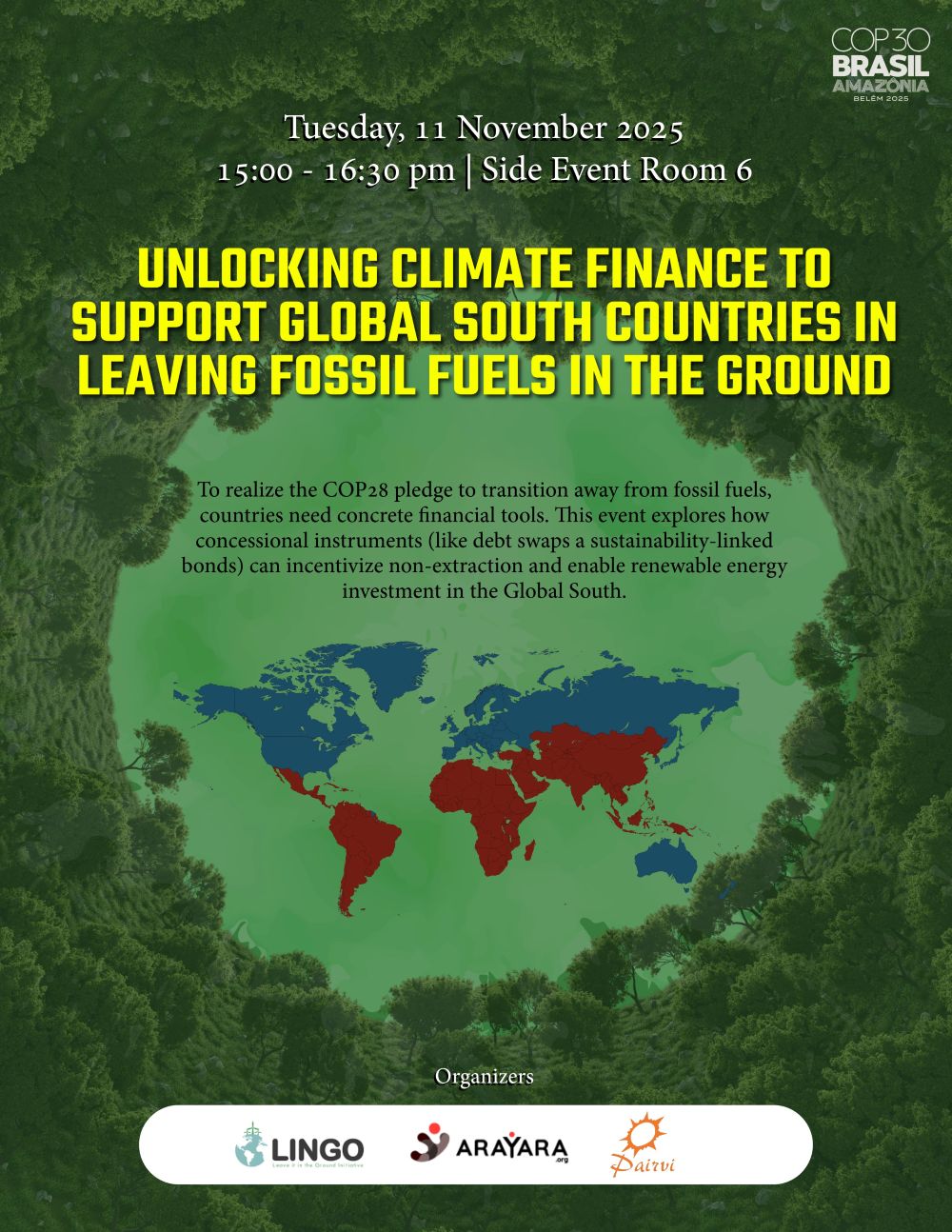 The side events focused on creating financial mechanisms for forest conservation for the global south countries as an incentive to prevent them cutting down standing forests. The topic of the discussion was extremely important in light of the COP 30 focus on forests and Brazil’s proposal of the Tropical Forests Forever Facility, being agreed by the COP. TFFF promises to create a financial mechanism to reward standing tropical forests at the rate of USD 1 per/ha and aims to cover 1 billion of tropical forests. The 20% of the proceeds will go directly to the Indigenous people and local communities. The mechanism also aims to raise and investment USD 125 billion at the rate of 4.5% pa and to earn a return of 7.5% pa to support the TFFF. Mr. Kjell Kuhne from LINGO emphasized that initiative like TFFF has lot of potential in incentivizing the countries from the global south to desist from deforestation. Another speaker from LINGO also referred to the ITT Yasuni initiative of the Ecuador, a similar mechanism to reward standing forest and underlined the importance of creating financial incentives for preventing deforestation as well as leaving fossil fuel in the ground. He added that Fossil Fuel Nonproliferation Treaty (FFNPT) and Just Energy Transition Partnerships are good examples to incentivize developing and resource strapped countries. He also explained that more than 2/3rd of the Fossil fuels need to be left in the ground to achieve the PA target of the 1.5 degrees, for which it’s critical that developing countries having fossil fuels must be dissuaded from using it through financial incentives.
Carmen Stibel Duarte Torres from Ministry of Environment, Govt of Colombia also highlighted its commitment to Climate Action and PA goals generally, and conservation of forests and energy transition in particular. She highlighted that Colombia is organizing first International Conference on Just Transition Away from Fossil Fuel on 28th & 29th April 2026 with the Netherlands.
Nicole Oliveira from Arayara International Institute said that while Brazil’s government is posturing to be pro planet and pro forests, it’s doing exactly opposite. She added that Amazon has been under seize and the Brazilian govt has allocated license for 126 oil and gas blocks recently including in Brazilian Amazon which puts 10 Million ha of high priority conservation areas and 14000 square Kilomemtres of mangrove at risk of extraction besides potentially affecting 2.7 million Idigenous people.
Soumya Dutta from PAIRVI, provided a critique of the TFFF. He highlighted that only protection of forests cannot save the climate as forests and land use change only result in less than 20% of entire global emissions, and stressed that unless the emissions from fossil fuel are addressed conservation of forest will only have very limited benefits. He also explained that besides the TFFF being a market based mechanism it does not provide enough incentive for protecting standing forests. he added that under the TFFF the incentive for forest carbon is only USD 60-70 cents per tonne, which is far less than the price it is traded in the carbon markets. He also added that until now there is not much clarity on the functioning of the mechanism and its rules, and therefore, the enthusiasm on the TFFF is misguided.
The panel discussion was followed by lively exchange of perspectives and experience of the indigenous communities, the contradiction between the Indigenous world view and market based mechanisms with many members in the audience cautioning over enthusiasm on the mechanisms like the TFFF.
Side Event: Prospects and Challenges for Real, Gender Just and People led Climate Solutions
14th November 2025, Side Event Room No. 4
Co organizers-Ibon Foundation, APWLD, FIAN International, FARN, Global Forest Coalition, Indigenous Peoples Rights International, Recourse & CECOEDECON
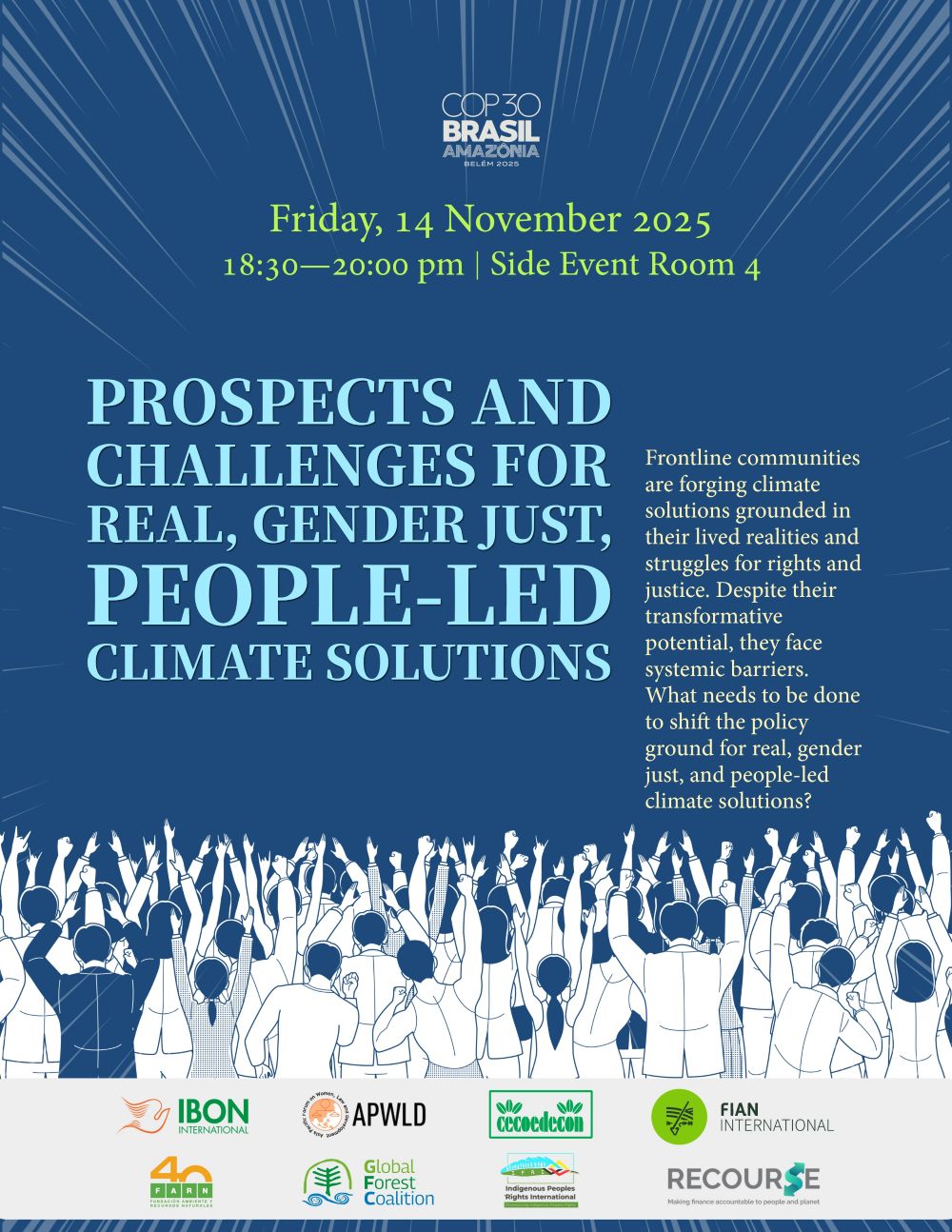 Valentina Figuera from the Global Forest Coalition moderated the event and opened with brief introduction of the title and the co organizers.
Joan Carling from IPRI focused on the just transition and Indigenous Peoples Rights. She questioned whether extraction of critical minerals for renewable energy is responding to the needs of the Indigenous peoples especially when there are lots of innovations in local renewable energy development by IPs with modest or no requirements of extractions? She added that large scale extraction mainly profit mining companies at the rights of the IPs and that in Asia Pacific, there 24 cases where mining companies in collusion of the government have criminalized 97000 IPs and resulted in their dispossession, illegal arrests and false cases.
Wanun Perempibul from APWLD and Climate Watch Thailand shared stories of women led solutions through rice cultivation not only in Thailand but across Asia pacific region. She shared that local communities, farmers, women, IPs and fisherfolk in the region are bounded by common thread of rice and producing climate resistant rice not only provide them food, small subsistence income and prevent them from false climate smart agriculture (mainly focused on export oriented agriculture) but also provided them sovereignty over their land, life and crop. She cited many expamples of cultivation of rice with low or no methane, but communities organizing themselves to overcome financial barriers.
Damaris Tamari from Fian International (Brazil) also shared examples of local communities developing best practices and seed conservation, forest conservation, floriculture, pisci culture and other small scale food production making them resilient against climate change impacts. She added that not only these communities have made food systems resilient through agro-ecological practices but they are also providing key solutions for nature, water and climate. However, she cautioned against the corporate onslaught on these livelihoods and demanded an internationally binding treaty on human rights and business.
Elisa Morger, UN Special Rapporteur on climate change and human rights said that now people are tired of COPs and it’s time to take some bold decisions. She informed the audience that along with the OHCHR, she is working on a Just Transition and Human rights Framework,” which might come up for discussion and adoption in the next COP 31.
Ajay K Jha from PAIRVI/CECOEDECON said that it’s not appropriate to talk only about people led solutions in the multilateral spaces as it completely misses the rights, justice and multilateralism dimension of the climate conversation. He focused on the adaptation and said that even though there is lot of enthusiasm on indicators for global goal on adaptation being finalized, in the light of lack of finances, it’s a myth that indicators will revolutionize the adaptation in the global south. He also busted the myths of how transformational adaptation is being defined without any aim to overcome the systemic barriers of finance being held captive by the global north and donors. He concluded that unless adaptation also addresses the inequality, hierarchical structure and domination of the global north on the finance and adaptation finance, adaptation cannot be truly locally led and transformational.