
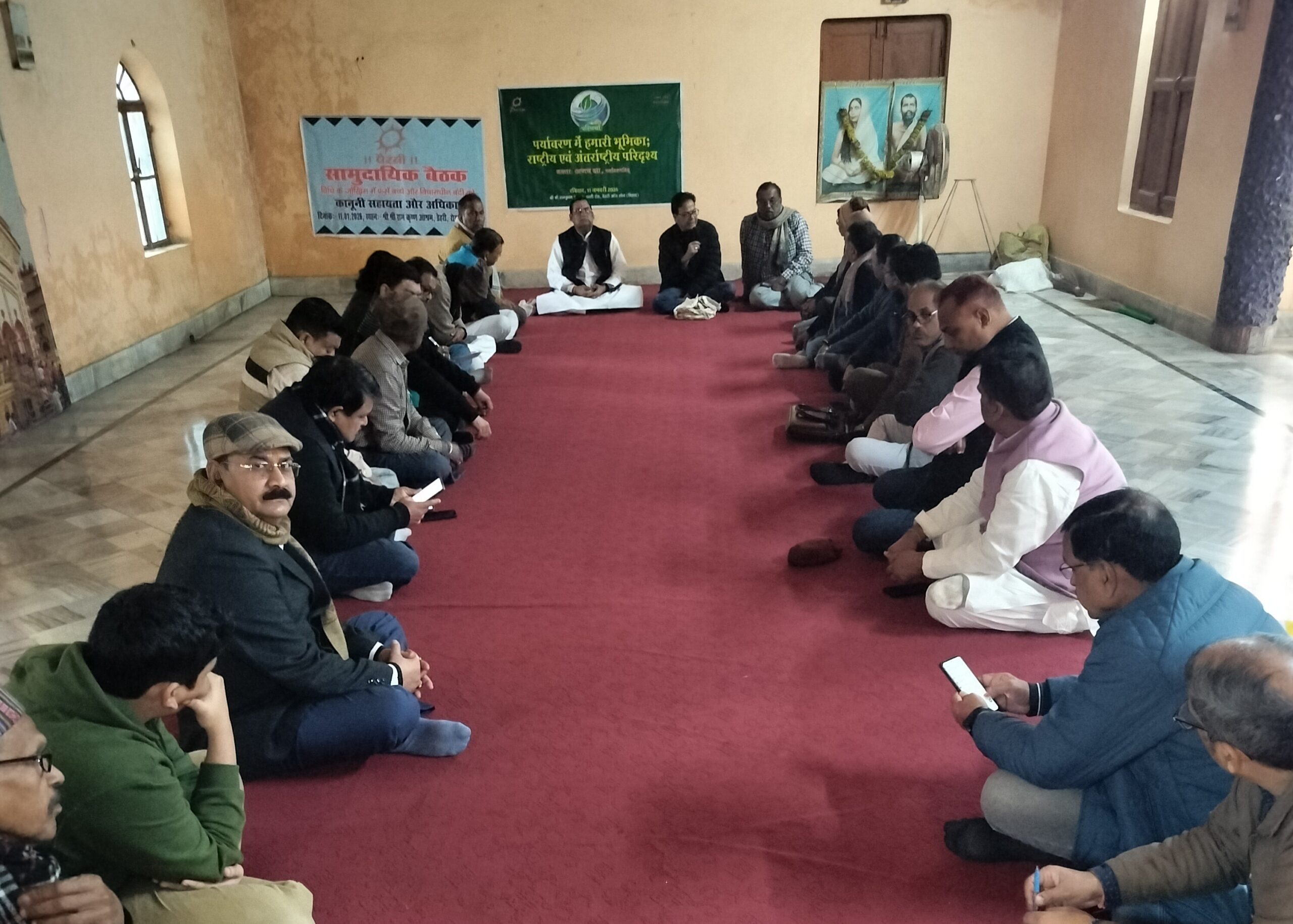
The Review and Planning Meeting held on 11 January 2026 at the Dehri office was organized to take stock of the ongoing programmes and activities under the APPI-supported project. The meeting was presided over by Ajay Jha, Lead Programmes, and witnessed active participation from all field staff, including Santosh Upadhyay, Bharat Bhushan Dubey, and Vivek Raj. The session focused on reviewing progress against planned activities, assessing field-level challenges, and identifying gaps in implementation. Detailed discussions were held on strengthening outreach, improving coordination with stakeholders, and ensuring timely delivery of project objectives. The meeting also served as a platform to plan upcoming activities, streamline reporting mechanisms, and enhance the overall effectiveness of programme implementation through collaborative inputs from the team.
This meeting was followed by a discussion on “Our Role in the Environment: National and International Perspectives,” at Sri Ram Krishna Ashram, Dehri -On-Sone. Renowned international environmentalist Ajay Jha delivered the key note address and highlighted that the world today is facing a severe crisis of global warming and climate change, with sudden and irregular weather changes deeply affecting agriculture, water resources, health, and biodiversity. He noted that while various theoretical solutions—ranging from market-based approaches to technological fixes—are being proposed globally, the central role of human behavior in driving the crisis cannot be ignored. Emphasizing existing inequalities, he pointed out that developing countries continue to rely heavily on fossil fuels such as coal, petrol, diesel, and gas for energy, contributing nearly 73 percent of global carbon emissions, while stark disparities persist in consumption patterns: about 25 percent of energy-related emissions are generated by just 1 percent of the world’s richest population, and the top 10 percent consume nearly half of global energy, whereas the majority of people live with minimal resources and exert far less pressure on nature. Stressing the way forward, he advocated for a transition to renewable energy sources like solar and wind, underlining that balancing development with environmental sustainability is possible only through such alternatives, and called for placing climate justice at the center of global action, asserting that the burden of the crisis must not fall on those who did not create it; he concluded by urging a serious rethinking of consumption patterns, energy policies, and development models to safeguard the planet for future generations, which remains both a national and global responsibility.