
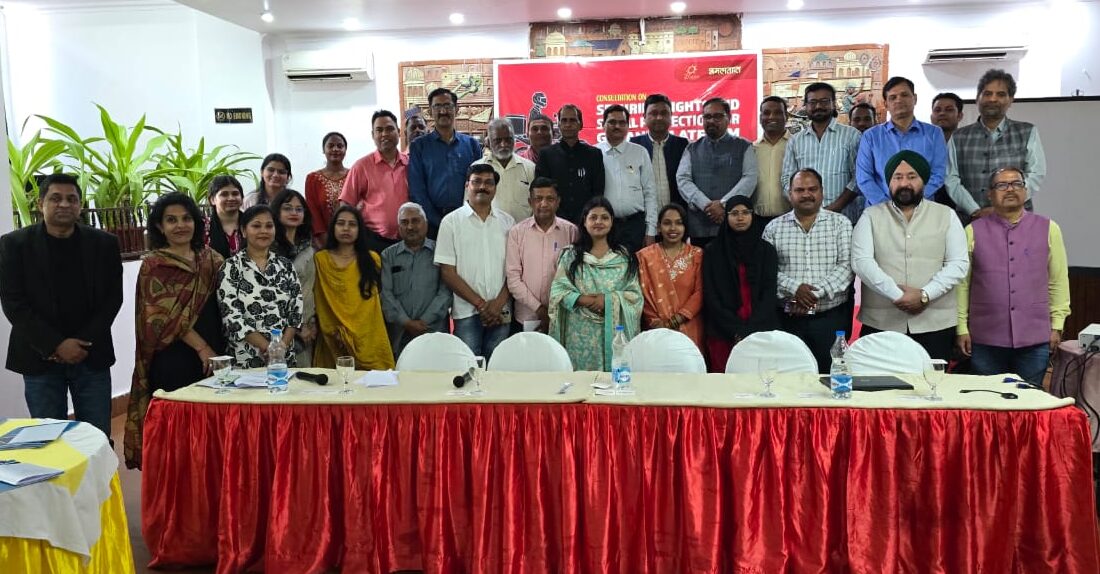
The Consultation on “Securing Rights and Social Protection for the Gig and Platform Workforce,” held on 1 March 2026 at Gomti Hotel, Lucknow, was jointly organized by PAIRVI and Amaltas, bringing together around 30 participants from trade unions, civil society, and labour rights groups. The discussion was opened by Dinbandhu Vats, who raised critical concerns regarding algorithm, delivery in 10 minutes, the non-recognition of gig workers as employees and their classification as independent contractors, which deprives them of basic labour rights and protections. He emphasized that such practices often violate international labour standards set by the International Labour Organization, and cited global examples such as the recognition of Uber drivers as employees in the UK and rider protection laws in Spain. He also reflected on recent Union Budget announcements concerning gig workers and questioned the current status and effectiveness of social security provisions for this workforce.
The consultation further included a presentation by AD Singh RMLNLU, Lucknow who highlighted the critical gap between the theoretical assumptions and practical realities of the gig and platform economy in India. In practice, gig workers experience disguised dependence on platforms for income, with algorithmic systems controlling pricing, work allocation, ratings, and even deactivation, thereby limiting real autonomy. Most workers lack basic labour protections such as minimum wages, job security, paid leave, health insurance, and effective grievance redressal mechanisms, while also bearing operational costs like fuel, devices, and maintenance, leading to income instability and risk transfer. These challenges are compounded by long working hours, stress, absence of collective bargaining, and increased vulnerability among women and marginalized groups. Labour union leaders Pramod Patel and Avinash Pande, highlighted the issues of income insecurity, lack of collective bargaining power, and unsafe working conditions. Legal perspectives were shared by Advocates Sandeep Jaiswal and Virendra Tripathi, who discussed gaps in the current legal framework and the need for stronger enforcement of social security provisions. Participants collectively stressed the urgency of establishing clear employment relationships, expanding social security coverage, and ensuring accountability of platform companies. A key focus of the consultation was the emerging scale and challenges of the gig economy in India. It was noted that the number of gig workers, estimated at around 7.7 million in 2020–21, is projected to grow to nearly 23.5 million by 2029–30, making it a significant segment of the workforce. Despite this growth, major issues persist, including lack of minimum wage guarantees, absence of health insurance and pension coverage, algorithmic control without transparency, and no effective grievance redressal systems. Participants also discussed the limited budgetary allocation and lack of clarity in implementation frameworks under recent Union Budgets, which, while acknowledging gig workers, fall short in ensuring universal and enforceable social security coverage. Key challenges identified included low awareness among workers, weak institutional mechanisms, data gaps, and resistance from platform companies to formalize employment relationships. The discussion emphasized that without clear policy direction, adequate financial commitment, and robust enforcement, the promise of social security for gig workers will remain largely unfulfilled.