
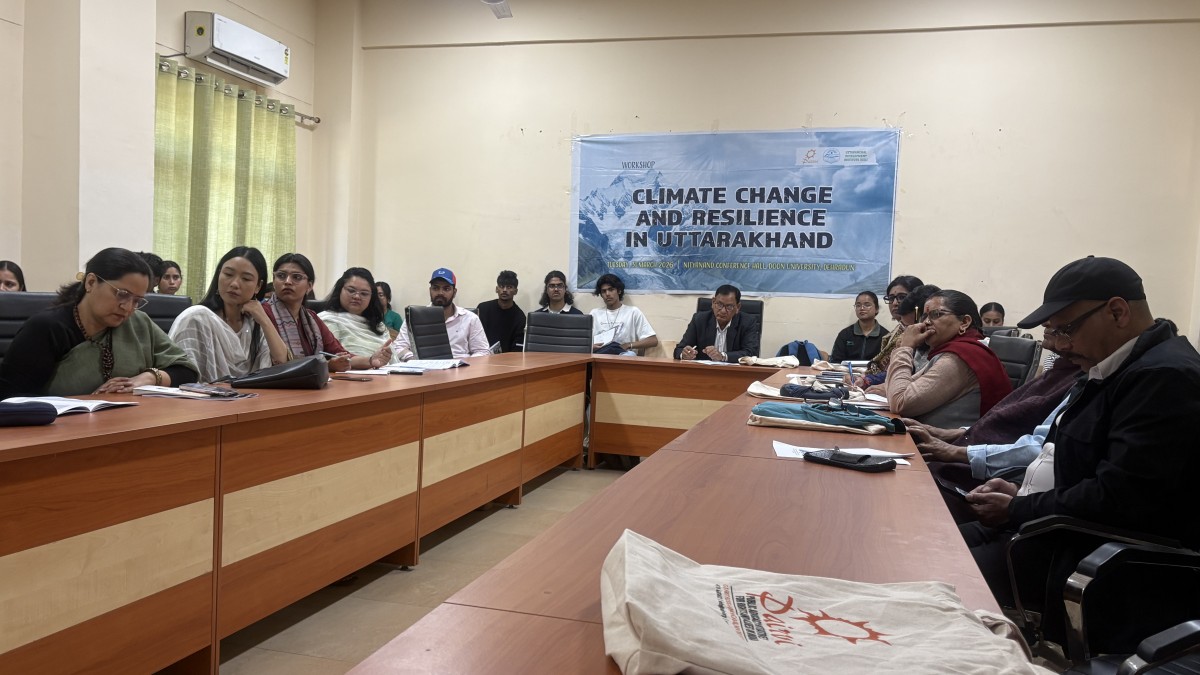
The Workshop ‘Climate Change and Resilience in Uttarakhand’ co-organized by PAIRVI, Department of Geography, Doon University and Uttaranchal Development Institute was held at Nityanand Conference Hall, Doon University, Dehradun on 31 March 2026, . The workshop, part of a broader series of state-level consultations by PAIRVI, brought together policymakers, researchers, civil society actors, journalists, and community leaders to deliberate on climate governance, adaptation, and resilience in the Himalayan region. Ajay Jha, PAIRVI highlighted the intensifying global climate crisis, noting rising temperatures, increasing extreme weather events, and disproportionate vulnerabilities in hill regions. Virendra Painuly emphasized the need for integrated socio-ecological frameworks, while Abhilasha Kannaujia underlined the critical role of indigenous knowledge systems in climate adaptation.
A key highlight of the workshop was the intervention by Distinguished Guest Padma Shri Kalyan Singh Rawat, who raised serious concerns about emerging climate risks in Uttarakhand, including the identification of more than 400 glacial lakes formed due to global warming, which pose a significant threat in the event of seismic activity. He emphasized the urgent need to bridge the gap between traditional ecological knowledge and modern scientific approaches. Drawing from field observations, he pointed to changing biodiversity patterns—such as wild boars in alpine bugyals and peacocks in higher-altitude forests—as indicators of ecological imbalance. He also stressed the importance of youth engagement with local realities to strengthen climate response.
Discussions further covered disaster preparedness, with Shantanu Sarkar highlighting the need for proactive landslide mitigation, early warning systems, and community awareness to reduce disaster risks. The workshop strongly reinforced the importance of community-driven and nature-based solutions. Experts including Megha Prakash, Suresh Bhai and Kusum Arunachalam discussed sustainable agriculture, water conservation, and the integration of traditional and scientific knowledge systems. Grassroots perspectives, including those of Shweta Badhani, highlighted the challenges and opportunities in promoting climate-resilient livelihoods. The workshop concluded with a consensus on the need for community-driven, nature-based solutions supported by effective governance and policy frameworks. Speakers including Rajni Devi, Gram Pradhan and Jai Raj, former PCCF, Uttarakhand emphasized the role of local institutions and state-level action plans in strengthening climate response. The workshop highlighted key priorities such as promoting sustainable agriculture, strengthening local governance, enhancing awareness, and integrating traditional and scientific knowledge systems.